
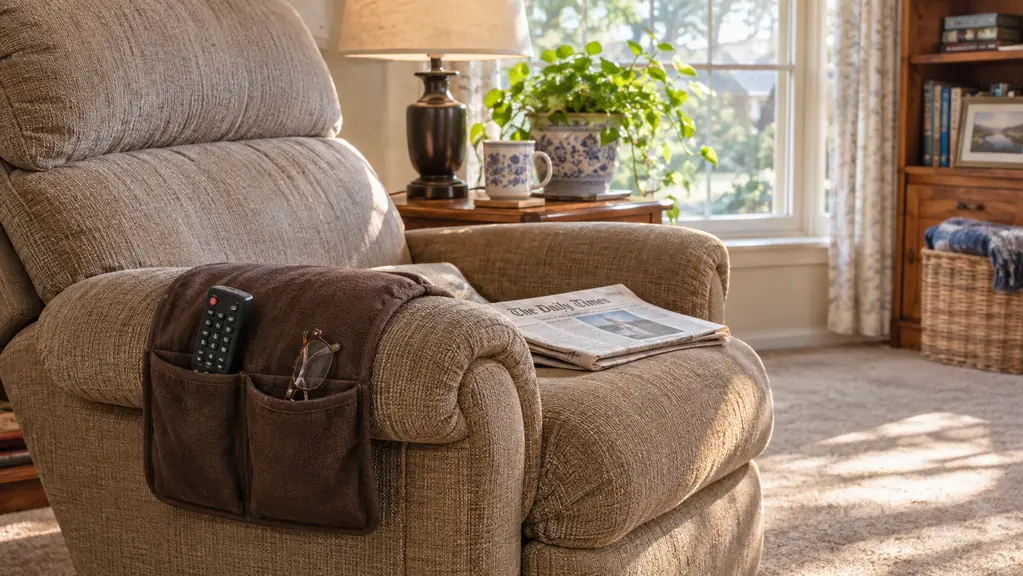
For about two years my TV remote lived at the bottom of the gap between the seat cushion and the arm of my recliner. Every evening I would pat the arm, pat the cushion, and then lean over and fish for it with two fingers. My knees are stiff, worst first thing in the morning and after I have been sitting a while, and it was never the remote that bothered me. It was the lean.
Here is what I finally counted. One evening in March I kept a tally, and I leaned out of that chair eleven times in an hour and a half. Eight of those leans were for something that should have been within arm's reach already: the remote, my reading glasses, a pen, my phone. So in April 2026 I ordered the AUVCAS armchair caddy, mostly because it was the only one I could find with five separate compartments instead of one deep sack you have to dig through. Seven months later it is still on the same chair, and this is how I set it up so it stays there.
Stop leaning out of the chair eleven times an evening
The AUVCAS caddy drapes over the armrest, tucks under the seat cushion so your own weight holds it, and keeps five things where your hand already goes. Non-slip backing, five compartments, 34.5 by 13 inches.
Amazon Check Today's Price on Amazon →Step 1: Measure the arm before you buy anything
I have a habit of measuring twice, and I am glad of it here. The caddy measures 34.5 inches long and 13 inches wide, and it wants a run of armrest to lie on. On my MCombo lift recliner it covers the arm from the front edge back to the hinge with a few inches to spare at the back. On a narrower club chair it would hang over the front edge, which is not the end of the world, but you would want to know that before the box arrives rather than after.
While the tape is out, look at what your chair already has. Mine came with a pocket on the side, and the wired hand remote for the lift lives in it. That pocket stays the hand remote's home. If I had moved that remote into the caddy, the cord would have dragged across my lap every time the chair moved. Measure the arm, then measure the arm again with the chair's own pockets in mind.
One more thing to look at, and it is the arm itself. My lift recliner has a padded fabric arm, and the underside of the caddy is a silicone non-slip netting that grips it. I have never tried this on a bare wooden arm and I will not pretend to know how it would do there. If your chair has hard wood or a very slick arm, plan on tucking the end under the cushion and testing it with something unbreakable before you trust it with your glasses.
Step 2: Tuck the end under the seat cushion, not just over the arm
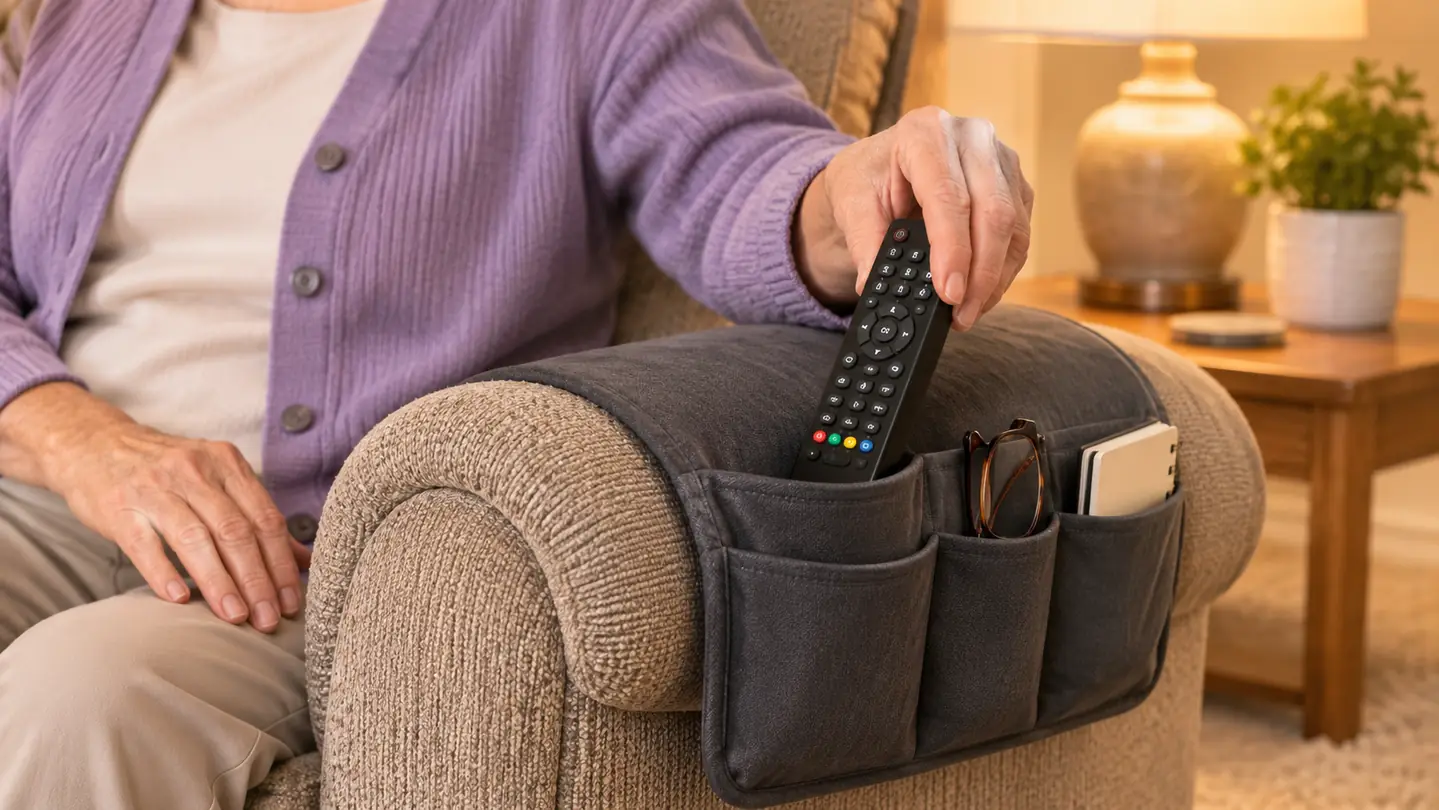
The AUVCAS listing is plain about this, and I want to repeat it, because it is the difference between the thing staying put and the thing sliding onto the floor. You place the end with the organizer down inside and underneath your seat cushion. On my chair that meant lifting the front edge of the cushion, laying the tail flat on the frame, and setting the cushion back down on top of it.
It took me about a minute the first time. The point is weight. When you sit down, your own weight holds that tail in place, and the caddy cannot walk forward. I set mine up in April 2026 and I have only had to redo it once, in July, when I took the slipcover off to wash it and lifted the caddy out along with it.
If bending to lift a cushion is hard for you, this is a two person job for about ninety seconds. My daughter Karen did the lifting and I did the pointing. There is no shame in that. Have somebody help you, and have them hand you the caddy so you can decide where the pockets sit before it goes under the cushion.
Step 3: Load the five compartments by reach order, not by what looks tidy
There are five compartments: one large pocket meant for newspapers, magazines and books, and four small ones. I use every one of them, and I use them wrong on purpose. The large pocket holds my crossword book. The four small pockets hold the TV remote, my reading glasses, one pen, and my phone.
The rule I settled on is this. Put each thing in the pocket your hand lands on when you are not looking. My right hand comes off the armrest near the front, so the remote is in the front small pocket. The glasses are next to it, because I take them off and put them back on a dozen times an afternoon. The phone is in the pocket nearest the back, where it is least likely to get knocked.
What I got wrong at first was the pen. I put it where it looked neat, which was the pocket closest to my body, and I stabbed myself in the hip with it twice before I moved it. Two weeks of that and I learned to load the caddy by my own habits instead of by the picture on the listing. The listing calls the capacity five loads, and I read that as one thing per compartment. Seven months in, that has held up.
Eight of those eleven leans were for things that should have been within arm's reach already.
Step 4: Keep the cords and the chair's hand remote out of it
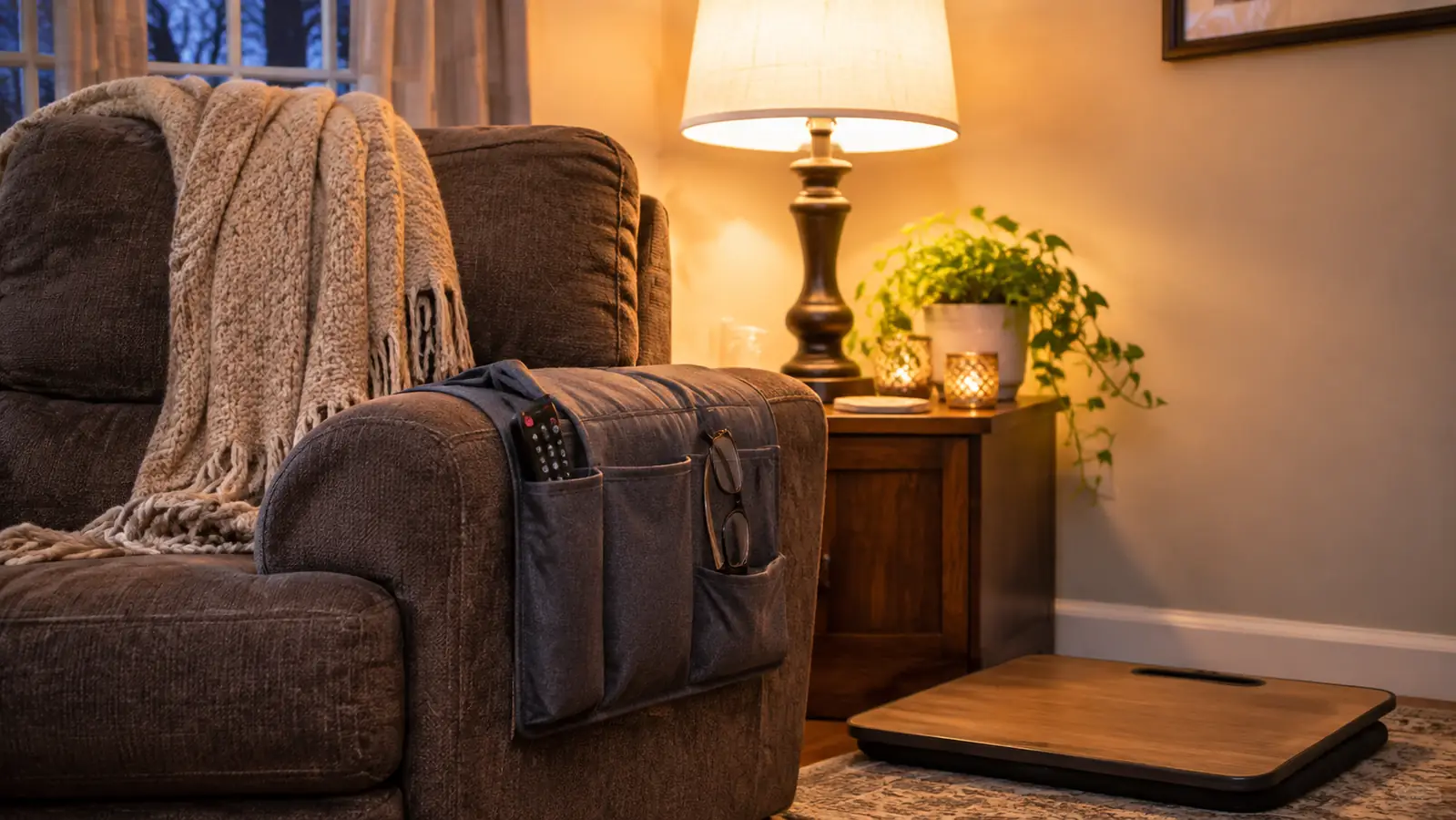
The caddy is for the things you reach for with one hand while you are sitting. It is not for the chair's controls. The lift chair's hand remote has its own pocket on the side of the chair and that is where it stays, cord and all. I never once put it in the caddy, and the reason is simple: the cord would have caught on the armrest every time the chair reclined.
Same idea for charging cords. My phone lives in the caddy, but I do not leave a cord draped over the arm of the chair. A cord across an armrest is one more thing to catch a sleeve when you stand up, and I have caught my sleeve on enough things already. If you charge your phone in the chair, run the cord behind the chair, not over the arm.
And it is not a cup holder. Nothing on the listing says it is, and I would not trust a fabric organizer with a mug of hot coffee anyway. My coffee sits on the little table by the window, same as it always has. That table was there before the caddy and it is still doing its job.
Step 5: Give it a two-minute reset in the morning and a reach test once
Any flat surface in my house becomes a pile if I let it. The caddy is no different. Newspapers stack up in the big pocket, a receipt goes in with the pen, and by the end of the week I am digging again. So now it gets emptied every morning with my first cup of coffee. Five things go back in. Everything else goes on the side table or in the trash.
The reach test is the other half of it, and you only have to do it once. After I had the caddy loaded the way I thought I wanted it, I sat down and reached for each of the five things without looking. Two of them I had to hunt for. I swapped those two items into different pockets and tried again the next day. That took about four minutes in total, and it is the reason I can find the remote in the dark now.
The one annoyance I will own up to: the caddy slides a little if I lean hard on the arm. Not off the chair, just enough that I notice it. When that happens I sit back up, push it toward the back of the arm with the flat of my hand, and it is fine for another few days. It has never dumped anything on the floor, and I have never had to take it off and start over.
What Else Helps
The caddy fixed the reaching, but it did not fix everything about the chair corner, and I would be lying if I said it did. The lap desk is what handles the tablet and the crossword book most afternoons. I bought my LAPGEAR desk in May 2026 and it sits across my lap with the cushions resting on my legs, and the phone slot holds my phone upright when I am on a video call with Karen. When I am done, it goes on the floor beside the chair, not on the arm.
The slipcover matters more than I expected, too. I put the Easy-Going stretch cover on in March 2026 after I spilled coffee on the arm in the chair's first month, and it is the reason the arm under the caddy is still clean. I wash it on gentle about every three weeks. When it comes off, the caddy comes off with it and goes back on the same way, tail under the cushion.
Now the plain thing, because I would rather say it than have you find out later. A caddy organizes what you reach for. It does not make it easier to get out of a chair, it is not a medical device, and it is not sold as one. If standing up from a low seat is the hard part of your day, that is a conversation for your doctor or for a physical or occupational therapist, not a shopping decision. I asked Dr. Patel before I bought my lift chair in February 2026 and I am glad I did. Ask about fit and safety before you buy anything you are going to lean on or push against, especially after a surgery or a fall.
One last habit, and then I will leave you to it. Before I press the button to stand, I set the lap desk on the floor and I put both feet flat. The caddy stays where it is. The chair does the work.
Seven months on the same chair, and it is the first thing I would replace
Five compartments, a silicone non-slip backing, and a tail that tucks under the seat cushion so your own weight holds it in place. Mine has been on the right arm of my recliner since April 2026 and it has never dumped anything on the floor.
Amazon Check Today's Price on Amazon →