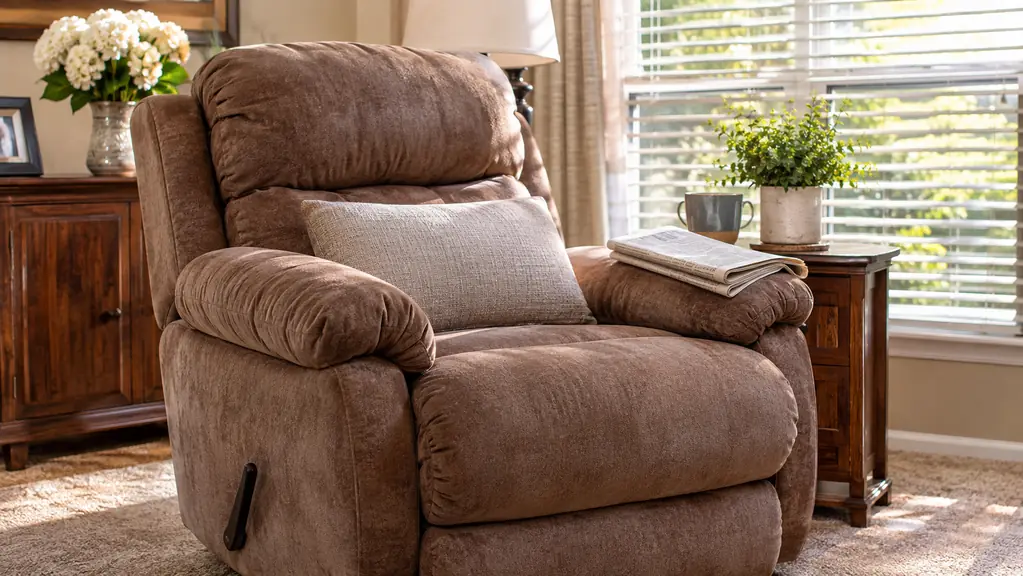
Here is what nobody tells you about a recliner. The back is built for leaning, not for sitting up straight. Mine is a MCombo lift recliner I bought in February, and I would not give it up, but when I raise the back to read the Gaston Gazette on my tablet, there is a hollow spot at the small of my back. My shoulders touch the chair. My hips touch the chair. The middle of me does not.
That hollow spot is why I bought the HOMBYS lumbar support pillow in July. Then I spent the better part of three weeks putting it in the wrong place, taking it out, and setting it somewhere else. What I learned is that a lumbar pillow in a recliner is not a decoration you fluff and forget. Position does almost all of the work, and there are five decisions to make, in order.
The gap comes first. The pillow fills it.
HOMBYS made this cushion for recliners in particular: 5 inches thick, about 20 inches wide, memory foam inside a cover you can machine wash. Mine has been in my chair since July. If your recliner leaves the same hollow at the small of your back, this is the gap it was built to fill.
Amazon Check Today's Price on Amazon →First, the Pillow Itself, and Why the Size Matters
The HOMBYS pillow is a rectangular memory foam cushion, 5 inches thick. The listing gives the size as 20 by 13.5 by 5 inches, and the dimensions line says 20 inches long by 14 inches wide, so figure on about 20 inches across, which is wider than a throw pillow from the couch. The cover is 100 percent polyester and comes off for machine washing. Mine arrived compressed the way foam usually ships, and I set it on the couch overnight to let it take its shape back before I put it in the chair.
Those numbers matter for positioning. Five inches is the part that fills the gap. Twenty inches across is the part that means you do not have to center it perfectly, because it covers hip to hip on me and I am about 5 feet 4 inches and 165 pounds. The rectangular shape sits flatter against a chair back than a round cushion, which wants to roll out from under you every time you shift.
Recliners make the gap worse on purpose. The back leans, the seat is deep, and the padding is shaped to hold you in a lazy S. That works when you are stretched out. When you bring the back up to read, the seat does not change, so your hips stay where they were while your back moves forward, and something has to give. Usually it is the small of your back, which ends up with nothing behind it. That is the gap, and it is why placement has to be low.
How to Position a Lumbar Pillow in a Recliner
Step 1: Find the gap with your hand, not your back
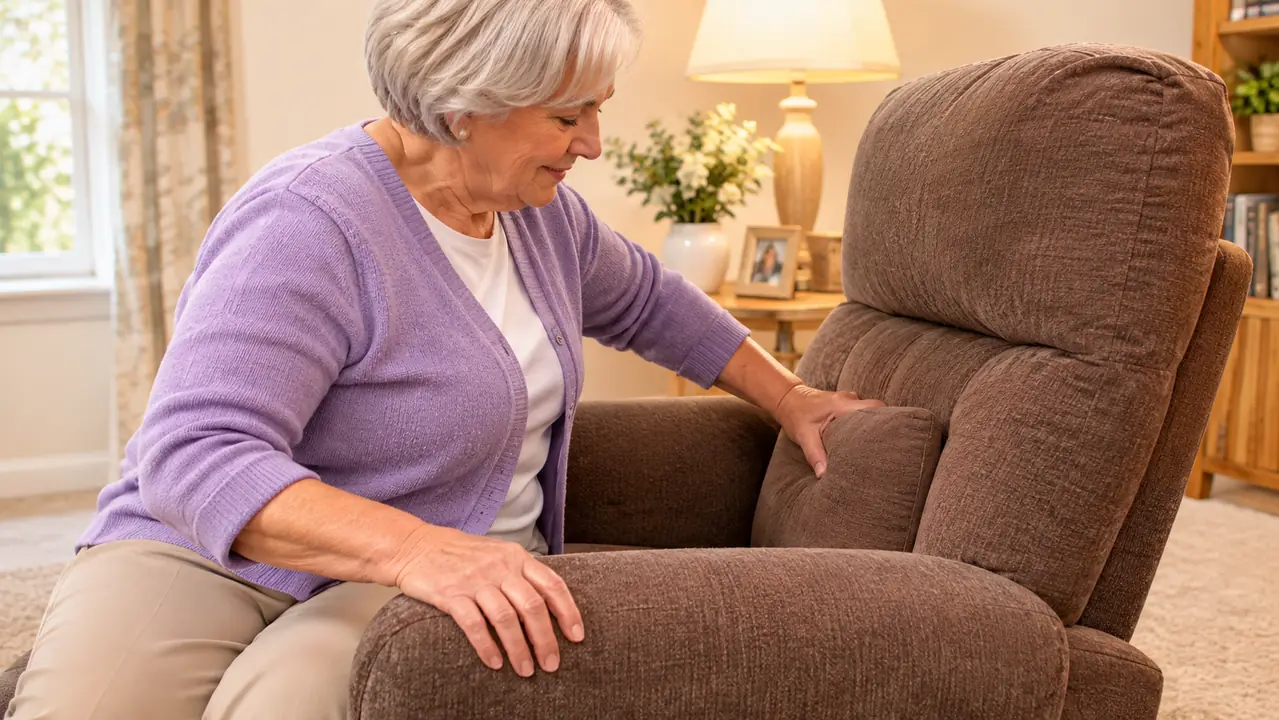
Before the pillow goes anywhere, sit in the chair with the back upright and both feet flat on the floor. Slide one hand behind you, palm flat against the chair, and feel for the place where your back and the chair part company. On me it is right at the small of my back, a little above my waist. On Walt, who is 74 and a couple of inches taller, it sits lower. That is not a problem with either of us. It is just how seats work.
That spot is where the pillow goes. Not where the tag says back support and not where it looks tidiest. The gap is the whole reason you bought the thing.
Where I went wrong, and where most people go wrong, is aiming too high. A pillow behind your ribs pushes your shoulders forward and your chin toward your chest, and after twenty minutes of the crossword your neck is the thing complaining. Too low is just as useless. If the cushion ends up under your hip bones, you are sitting on it, not against it, and it will not stay put for a minute.
Step 2: Put the pillow in the chair before you sit down
Set the HOMBYS pillow into the chair first, centered, and press it down into the crease where the seat meets the back. Then sit down and slide back until your hips are against it. That order matters with memory foam. Foam takes a few seconds to warm and shape, and if you shove the pillow behind you after you are already seated, it bunches into a lump instead of easing into a curve.
The first week I had mine, I put it behind my shoulder blades, because the words back support made me think of the whole back. My neck ended up craned forward and I blamed the pillow. It was not the pillow. It was six inches too high.
Aim for the middle of the cushion to land on the gap you found with your hand. Because it is 20 inches wide, side to side is forgiving. Up and down is not forgiving at all.
Step 3: Sit all the way back, then check where your hips land
Here is the test I use. Sit down, slide back until your tailbone is against the seat back, and put both feet flat. If you feel like you are perched on the front edge of the seat, the pillow is too far forward or you have not slid back far enough. If your lower back is touching foam and your hips are still on the seat cushion, you have it.
Five inches of foam is a real amount of foam. On a chair with a soft, saggy back it sinks into the padding and does very little. On a firm back, which the MCombo has, it does what it looks like it will do. If your recliner is older and worn soft, you may have to press the cushion down harder into the crease to keep it where you put it.
One more check, and this one took me a while. Look at your knees. If sitting against the pillow pushes you forward so your knees ride higher than your hips, the cushion is wrong for that chair, or you need one notch of recline. I keep the back one stop off full upright for reading and that fixed it for me.
It was not the pillow that was wrong. It was six inches too high, and I had blamed the pillow for a week.
Step 4: Test it at reading angle, then test the recline
The tricky part about a recliner is that the chair moves and the pillow does not. You set it at the small of your back, then you press the hand remote and the back goes down, and the cushion stays where it was, which now means it is behind your shoulder blades or under your ribs.
So test it before you trust it. Sit upright at the angle you actually read at, which for me is one notch back from straight up. Then use the wired hand remote to go back slowly and pay attention to where the pillow ends up. Mine rides up a little. Yours may not. It depends on how steep your chair's back is and where the crease sits.
For naps I take mine out entirely and set it on the couch. The reclined position does not need it, and leaving it in means waking up with it jammed under my ribs. That is a preference, not a rule, but it is what four months of afternoons taught me.
Step 5: Reset it every time you stand up
This is the annoyance I will admit to. The HOMBYS pillow slides down when I stand, because I push off the armrests and my back drags it. By the time I come back with my coffee, it is halfway to the seat.
The fix takes two seconds. Before you sit back down, put a flat hand on the pillow and press it back up into the crease. Do it every time and it stays where you want it. Skip it and you will be fishing it out from under you all afternoon.
A lift chair adds one more wrinkle. When the chair lifts to help you stand, the whole seat tips forward, and anything loose in the seat goes with it. I learned that with a paperback. The pillow stays put because it is wedged into the crease, but if yours is riding loose on the seat, take it out before you press the lift.
What Else Helps
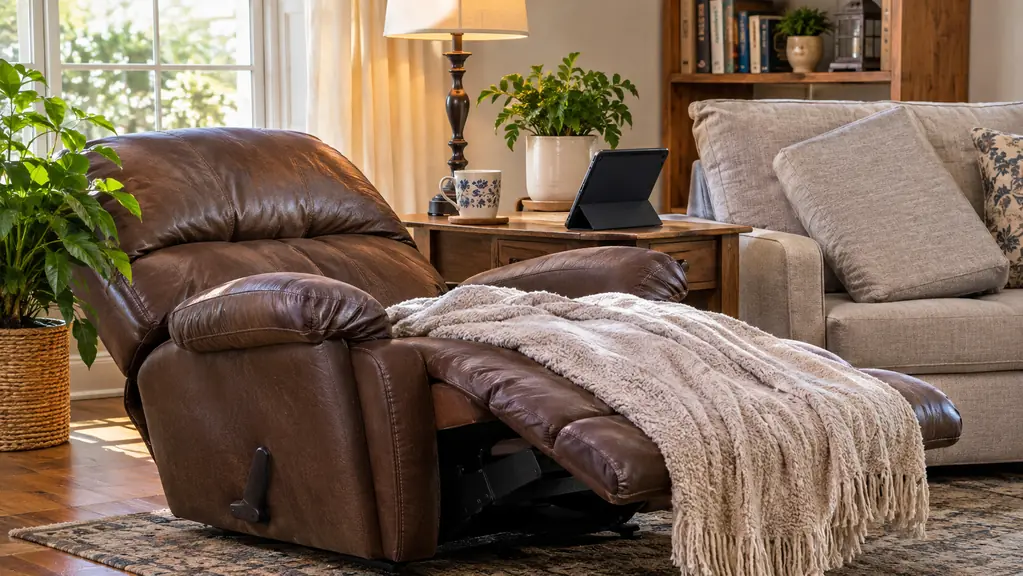
The pillow is not the only variable. The angle of the chair matters just as much. Most recliners have a stretch, usually one notch before full upright, where the back is still shaped like a chair but steep enough to read at. Stop there instead of fighting the top notch.
A throw pillow from the couch will get you through a few weeks. That is what I did before July. Mine went flat in the middle and had to be folded in half, and a folded throw pillow is a lump, not a cushion. A rolled blanket is worse. The reason the HOMBYS cushion works where those did not is the 5-inch thickness. It holds its shape and does not need re-fluffing every hour.
Keep what you reach for within reach. I hang a caddy on the right arm of my chair with my reading glasses and the TV remote in it, so I am not twisting sideways to grab things while I am propped against the pillow. Twisting is what pulls a cushion out of place. Keep the footrest even too. One foot up and one foot on the floor means you will shift your weight, and the pillow goes with you.
About once a month I take the cover off and wash it. The listing says machine wash and the fabric is 100 percent polyester, so I run it on gentle with the rest of my light laundry and hang it over the back of a kitchen chair to dry. The foam insert stays out of the machine. While the cover is off, I press the foam with both hands to see whether it is holding its shape. Four months in, it still is.
One last thing, and I mean it. If sitting is uncomfortable enough that you are rearranging cushions every evening, or you have had a surgery or a fall, talk to your doctor or a physical or occupational therapist before you buy anything for your chair. They can tell you what position your back should be in. I can only tell you what worked in my living room in Gastonia.
Four months in, mine is still in the same spot
The HOMBYS lumbar pillow has been in my chair since July. The only upkeep is pressing it back into place when I stand and washing the cover once a month. Start with the gap, not the pillow, and you will get it right faster than I did. Check today's price on Amazon.
Amazon Check Today's Price on Amazon →