

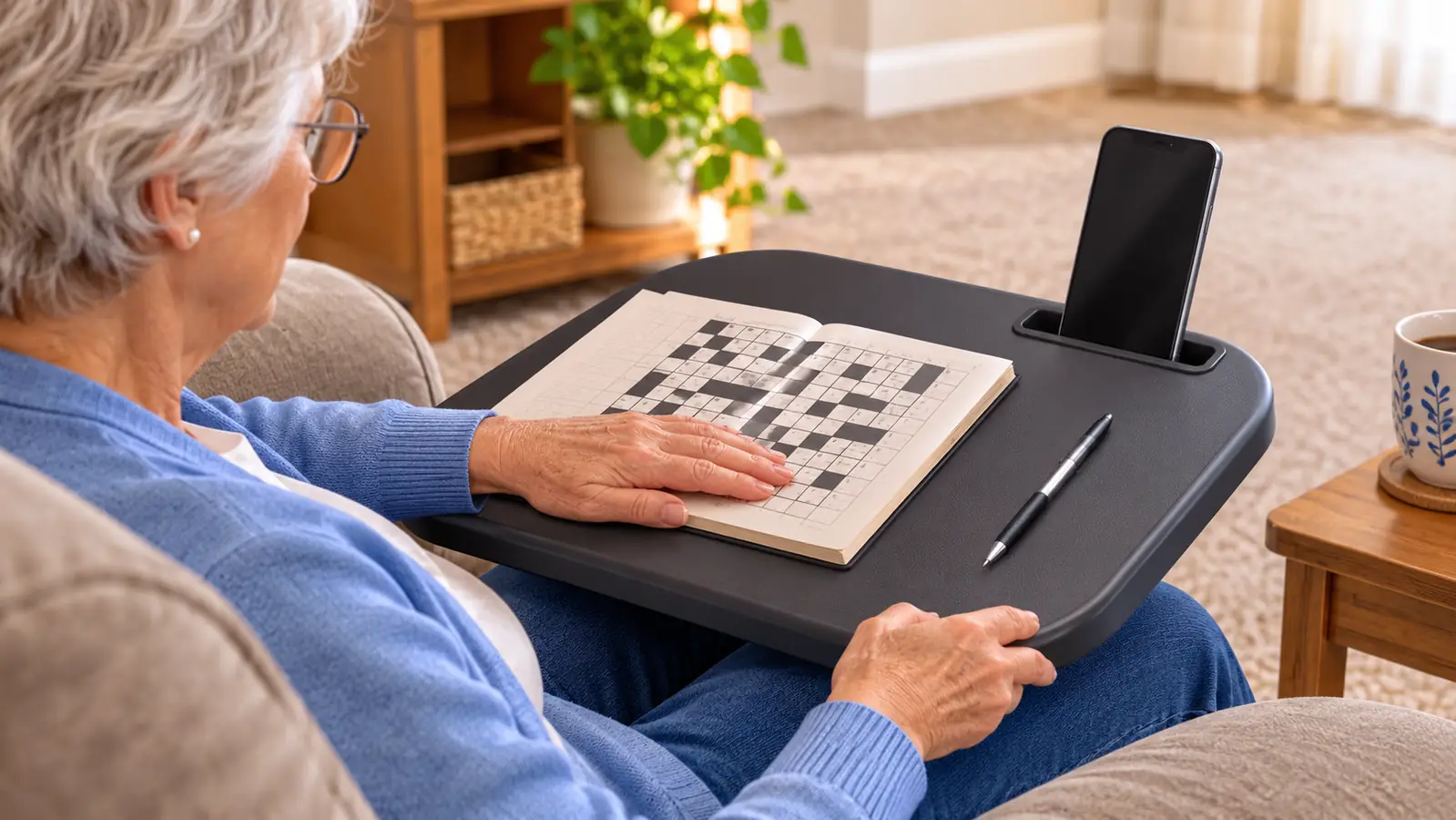
The metal folding TV tray that used to stand beside my chair is in the hall closet now, behind the vacuum cleaner, and I have not missed it once. What took its place in May is a LapGear Home Office Lap Desk, and it has been on my knees every afternoon since. A bed tray with legs is the other thing people bring up when I tell them I read in a recliner all afternoon. I have picked one up in a store twice, turned it over, looked at how the legs work, and set it back on the shelf both times. So this is not two products I own going head to head. It is one I use daily against one I have only handled.
So here is the short answer, and then I will show my work. If your chair is a recliner and the job is a tablet, a crossword book, or a letter to your cousin, the lap desk wins and it is not close. If the job is a plate of food in a bed, or in a chair with clear floor on both sides and somebody to hand you things, a tray with legs does that one job better than anything that sits on a lap can. Nobody needs both. Most people need to figure out which one their day actually looks like. I know that because I spent two months trying to make the TV tray work before I gave up on it. It was metal, it folded, and it stood beside the chair with the top at about the height of my elbow. The trouble was that it only had one place to be. If I wanted to lean back, the tray was behind me. If I wanted to sit up and write, I had to pull it around in front, and then it was between me and the television. The lap desk does not have that problem, because it goes where my hands go.
| LapGear Home Office Lap Desk | Bed tray with legs | |
|---|---|---|
| What holds it up | Two bolster cushions rest on your thighs | Four legs reach the floor on either side of you |
| Getting up with it in place | Lift it off and set it on the floor, and the cushions clear your knees | Swing the legs out first, then stand, or lift the whole tray aside |
| Weight on your legs | 2.1 pounds spread across your lap | Nothing rests on your thighs at all |
| Surface | 21.1 inches wide and 12 inches deep, with a built-in device ledge | A tray sized for a plate, a cup and a napkin |
| Keeping a tablet or book in place | Built-in device ledge and a 5x9 inch mouse pad that grips | A raised rim around the tray edge |
| Reading in bed with your legs stretched out | The cushions need a lap underneath, so it tips on flat knees | The legs stand on the mattress and the surface stays level |
| Writing or a crossword | Solid surface with an edge to brace a book against | Flat tray, and the rim can catch your wrist |
| Storing it when you are done | Slides under the chair or stands on end in a closet | Folds on some models, but the legs take up floor space |
| Cleaning up crumbs | Wipe the surface, and the cushions spot clean | Wipe the tray, and crumbs work into the leg joints |
| Warranty | 90 days on workmanship, stated on the listing | Set by the maker, so check before you buy |
| Best for | A tablet, a crossword and birthday cards in a recliner | Meals in bed, or in a chair with floor on both sides |
Do not read that table as a scoreboard, because it is not one. Three or four of those rows decide the whole thing for most people, and they are not the same three rows for everybody. If you cannot sit with anything pressing down on your thighs, the tray has already won and the rest does not matter. If you get up and down several times an hour, the lap desk has already won. The rows in the middle are the ones worth arguing about, so let me argue them.
Where LapGear Wins
The first thing the LapGear does better is get out of your way. When I stand up I put my hands on the armrests, and the desk comes off my knees and goes onto the floor beside the chair in one motion. I do not swing anything out, unfold anything, or look for a spot to set down a tray that still has a cup on it. The dual bolster cushions underneath are the reason that works. They sit on the thighs and lift off clean, and there is no frame to catch on the chair. When I sit back down, the desk goes back on my lap and everything I had on it is still there, because nothing slid off while it was down there.
The second thing is the surface itself. It is 21.1 inches wide and 12 inches deep, which is more room than a tray needs to hold one plate. I spread a folded newspaper out on it, or a crossword book with the pencil on one side and a cup on the other, and it does not feel crowded. There is a 5x9 inch mouse pad built into the surface, and a phone slot that holds my phone upright where I can see it. I do not own a laptop, so the mouse pad has never held a mouse, but it is a slightly different texture and it keeps a paperback from sliding when I put the chair back a notch. The whole thing weighs 2.1 pounds, light enough that I have carried it out to the porch without thinking about it. For scale, the tray I used to keep beside the chair was about wide enough for a plate and a glass, and that was all it was good for. When I laid the crossword book on it, the book hung over one edge. On the LapGear the same book sits with inches of surface showing on either side, and the pencil does not roll off onto the carpet. That sounds like a small thing. It is not a small thing when you are the one bending down to fetch a pencil out from under the chair.
The third thing is the phone slot, and I did not expect to care about it. My daughter Karen calls on Tuesday and Sunday afternoons, and I used to balance the phone on the armrest and lose the call every time I reached for my glasses. Now it stands up in the slot and I can see her face while I talk. The built-in device ledge does the same job for my tablet when I read the Gaston Gazette on it. Those two details cost nothing and they are the reason I stopped using the TV tray, which had neither. Last Tuesday she called while I had the crossword open, and I talked to her for twenty minutes with the phone standing in the slot and the puzzle still flat in front of me. On the old tray I would have set the phone down, lost it behind the book, and ended up calling her back from the kitchen.
Where a Bed Tray With Legs Wins
I will be honest about the legs, because the legs solve something a lap desk cannot. A tray with legs stands on its own. Nothing rests on your thighs, which matters if your lap is not a comfortable place to set two pounds for an hour, or if you have a blanket bunched up and a flat cushion will not sit level on it. The tray surface stays horizontal no matter what your knees are doing underneath. When I picked one up in the store, the legs folded flat against the tray and the whole thing was not much heavier than my lap desk. For a bowl of soup, that flat self-supporting surface with a rim to catch a spill is the right tool. I would not try to eat soup off my knees, and I would not tell anybody else to. I have handled two of them now, both at the home goods store over in Gastonia, on two trips about a month apart. Both had legs that folded flat underneath and a rim of maybe half an inch around the edge, and one had a way to raise the top a little. I stood in that aisle with one in my hands, thought about where I would put it down when I was done, and could not answer the question. There is floor on one side of my chair and a wall on the other. A tray with legs wants floor on both.
The other place a tray with legs wins is a bed, and I say that from looking rather than from trying. In a bed with your legs stretched out flat, my lap desk has nothing to sit on. The cushions need a lap underneath them, and set on flat knees it tips forward the moment you press on the far edge. A tray with legs stands on the mattress on either side of you and the surface stays where it was put. That is a real advantage and I am not going to pretend otherwise. The catch is that the legs then have to go somewhere when you get up, and while the tray is over your lap, those legs are between you and the floor. That is the honest reason I never bought one. I do not eat in bed and I do not read in bed. I read in the chair by the window with my feet up on the footrest, and there the lap desk sits exactly right. If my days looked different, if I carried my breakfast to the bedroom or spent my mornings lying flat with a book, I would have bought the tray and I would probably be writing this the other way around. Judge it by where you actually sit, not by which one sounds sturdier in the aisle.
The one that lifts off your knees in one hand
Two bolster cushions, a built-in device ledge, a phone slot and a 5x9 inch mouse pad. 21.1 inches wide and 12 inches deep, 2.1 pounds, and a 90 day workmanship warranty. Mine has been on my knees since May.
Amazon Check Today's Price on Amazon →
How I Compared Them, and What I Did Not Test
I should be plain about what this is based on. I have used the LapGear lap desk since May, most afternoons, in the same recliner by the front window. I have handled two bed trays with legs on store shelves, and I have watched a friend at church use one beside her chair, but I have never bought one, taken one home, or eaten a meal off one. So the tray paragraphs above come from the design and from watching, and the lap desk paragraphs come from six months of my own afternoons. Weigh the second kind of evidence more heavily than the first. That is what I would do if I were reading this instead of writing it.
What I did not test on either one: how tray legs behave on thick carpet, whether a particular maker's legs lock, or how either surface holds up under a hot plate. I also did not test the mouse pad as a mouse pad, since there is no laptop in this house. What I did test on the lap desk is the part that matters to me. Can I get out of the chair without help while it is on my knees. Does a tablet stay upright when I put the chair back. Does my coffee cup stay put when I reach across it. The answers were yes, yes and yes. I did measure the distance between my armrests with a cloth tape before I ordered, because I wanted to know whether the desk would drop down between them when I let go of it. It does not. I set it flat on the floor instead, on its side, where the cushions keep the surface off the carpet. The one annoyance is that the cushions hold warmth, so in July I started turning the desk over to let the underside cool while I ate lunch.
21.1 inches wide, 12 inches deep, 2.1 pounds, and it lifts off my knees in one hand when I stand.
Who Should Buy Which
Buy the lap desk if your day looks like mine. A recliner, a tablet with the newspaper on it, a crossword book, birthday cards in February, and nobody handing you things. Buy the tray with legs if the job is meals, if the tray needs to stand on its own because your lap is not a good shelf, or if you read in bed with your legs out flat. If you are shopping for a parent and you are not sure which, watch where they sit and what they hold. If they are in a lift chair or a recliner most of the afternoon with a book or a tablet, the lap desk is the safer guess. If they eat breakfast in bed, it is the wrong guess.
One more thing, and I mean this for the grown children doing the shopping as much as for anybody my age. I am not a nurse, and I am not a physical or occupational therapist, and I cannot tell you what is right for your hips or your back. Ask your doctor, or ask a therapist, about what you sit in and how you get out of it, especially after a surgery or a fall. A lap desk is a flat surface with two cushions on the bottom. It is not going to fix anything and it is not going to make anything better. It just makes an afternoon in the chair easier on the hands, and some afternoons that was enough for me.
What I reach for every afternoon at one o'clock
The LapGear Home Office Lap Desk has been on my knees since May, and the TV tray is still in the hall closet. If your chair is a recliner and your hands are holding a book or a tablet, this is the one I would buy again.
Amazon Check Today's Price on Amazon →